

Ambition Versus Capacity

In March 2026, Planning and Development InSite interviewed 25 team members of the Carter Jonas Planning Team to determine how the government’s progress to date is perceived.
This article draws on the responses of residential planning professionals across our London, Oxford, Cambridge, Leeds, and Manchester offices, focusing on the period since the current government came to power in July 2024. It is not a political scorecard, but a glimpse of what is changing and what still requires change.
What our pulse survey captures
Those working in the planning and development arena probably don’t need a survey to tell them that although the policy direction is firmly pro-delivery, the day-to-day mechanics of taking development schemes through the often arduous local plan process and achieving planning consent have not yet lessened.
Our survey puts some numbers against those instincts and shows how consistent the view is across geographies, sectors and different stages in the planning process.
Confidence quantified
Inevitably our first question was whether the government is likely to meet its ambitious target of delivering 1.5 million net additional homes by 2029. 72% of respondents scored the likelihood at between 0 and 2 out of 10: a sober assessment of the production line.
Asked about the reasoning behind their lack of faith, several respondents pointed to the time lag between policy change and housing completions. Others emphasised that the fundamentals – construction capacity, infrastructure and local plan coverage – have not shifted simply because the national mood has changed.
Emma Winter, based in our Leeds office, stated that the main reason was, ‘Delays in the planning system, specifically in relation to statutory consultation responses and the determination of planning applications’, while Harvey Moodley, in our London office, identified that, ‘Inadequate resources at local planning authorities leading to slow determination of planning applications, rising costs, and delays during construction will all contribute to difficulties in reaching the Government’s target.’
Andy Cowan in our Manchester office clearly saw the target as highly challenging: ‘Historically, it has proved difficult to deliver a consistent amount of homes to achieve the government's targets and the difficulties are compounded by economic headwinds, lack of capacity in the planning system and infrastructure constraints.’
The bottleneck: decision speed and capacity
Almost half of respondents (44%) said determination times and certainty for major residential schemes have worsened since July 2024. A further 40% say determination times have not changed. Only 4% report an improvement.
When asked what has deteriorated most in day-to-day work, decision speed was the most common answer (48%). Plan progress followed (16%), alongside concern about client confidence (12%). Meanwhile 56% said that nothing has improved in their day-to-day work, although 20% pointed to increased policy clarity and 12% to appeal outcomes.
Lack of local authority resource was commonly cited, and the issue runs deeper than simply officer numbers. It also concerns the reliability of the process: statutory consultation times, internal governance, the confidence to sign off recommendations and the ability to sustain a consistent approach when teams change. Each of these factors adds to the risk experienced by developers.
What is fixable?
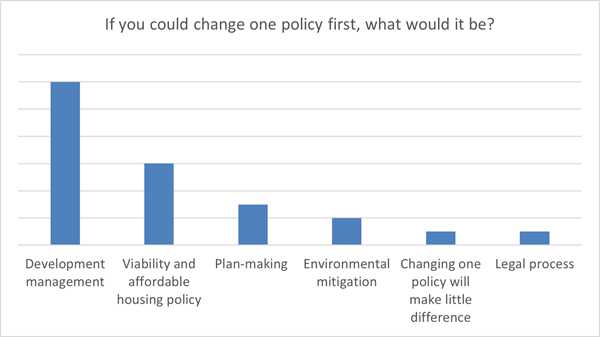
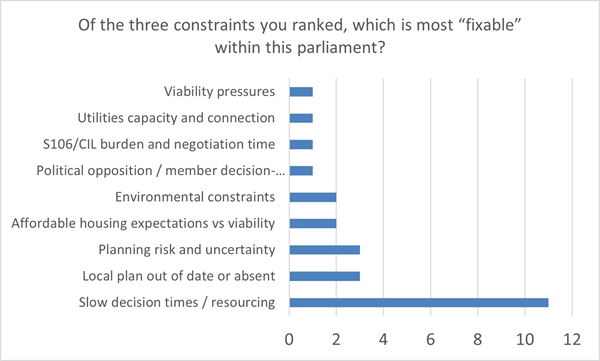
When asked what single policy lever they would change first, 48% chose development management resourcing and 24% chose viability and affordable housing policy. When asked which constraint is most fixable within this parliament, 44% selected development management resourcing and decision times.
When constraints were ranked by their significance, 80% placed development management resourcing and decision times among the top three constraints. It was also ranked first by 48%. The next tier is telling: 44% included viability pressure in their top three and 40% included planning uncertainty.
In terms of what is fixable, it is important to bear in mind that, while the local elections are being branded as ‘mid-terms’ because of their significance to the Labour Party politically, we have not yet reached the middle of this Parliament (that date falls in mid-January). From the local elections on 7 May this year to a likely general election date of early July 2029, the government still has 1,154 days to turn the situation around.
So how can it use those 1,154 days to best effect?
Much has been said about allocating more land and using tools such as the newly defined Grey Belt. While these factors are significant, our survey implies that for the next couple of years, the delivery dividend will come as much from the speed and predictability of decisions as from the wording of national policy.
Grey belt: more use, modest confidence
A large proportion, 64% of respondents, have been involved with planning applications for Grey Belt land since the definition officially entered the lexicon in December 2024’s NPPF. On the introduction of the policy, Carter Jonas’ Planning team has given advice, identified opportunities in local plans and made planning applications for Grey Belt sites. Among those with direct experience, 88% have already used the Grey Belt argument to support the case for development. That said, of those, only 40% were confident in the consistent interpretation of Grey Belt policy.
A significant aspect of this policy concerns affordable housing: the current NPPF (December 2024) makes a requirement for affordable housing on Grey Belt sites at 15 percentage points above the highest existing affordable housing requirement that would otherwise apply, capped at 50%. Where there is no pre-existing requirement, 50% affordable housing applies by default.
On the affordable housing uplift, 81% said viability is ‘partly site dependent’. This demonstrates that the uplift is being tested scheme by scheme: it is not wholly unworkable but must be addressed in the context of sales values, abnormal costs, build costs, phasing and the strength of the registered provider market.
Jenny Turner in our London office commented, ‘In theory, Grey Belt has the potential to substantially increase supply, but too often statutory consultees slow down the process and cause delay’.
A ranked risk question reinforces that view: local politics and community opposition sit at the top, followed by delay through challenge and viability considerations. Grey belt may help shape an argument, but it does not remove the need to build a scheme that is robust, locally intelligible and financially deliverable.
What would raise certainty by 2029
Looking ahead to what needs to change before the next general election – the target date for 1.5 million new homes – 56% of respondents selected LPA resourcing as the single biggest lever to increase certainty. Policy stability was next at 16%, followed by a different approach to viability and affordable housing at 12% and infrastructure delivery at 8%.
Speaking at UKREiiF in May 2025, Matthew Pennycook said the ‘major planks’ of planning reform would be in place by the end of the year, with the focus then shifting to delivery.
At the time that comment attracted some opposition. But with the Planning and Infrastructure Act now on the Statute Book and a further version of the NPPF in the pipeline, most would agree that policy has indeed moved on from July 2024. What remains to be resolved is a robust and reinforced approach to delivery – well-resourced teams, predictable processes and clearer positions on viability and contributions so that negotiations can conclude and build programmes can be trusted.
|
Headline survey results |
|
| Metric | Result |
| Likelihood of delivering 1.5m homes by July 2029 scored at 0-2/10 | 72% |
| Determination times and certainty have worsened since July 2024 | 44% |
| Would change development management first (policy lever) | 48% |
| Development management resourcing is the most fixable constraint | 44% |
| Local planning authority resourcing is the single biggest certainty lever by July 2029 | 56% |